
40 Minutes of Funk Further: Thirty Years of Funkestra, FUNKOPIA and a Few Stories Along the Way
Almost four years after my first conversation with Michael B on 40 Minutes of Funk, I was invited back.
There was a particularly nice reason for it. Michael has introduced a new occasional strand called 40 Minutes of Funk Further, bringing previous guests back to find out what has happened since their first appearance.
Quite a lot, as it turns out.
Michael and I first spoke in October 2021. Since then, collaboration has moved even closer to the centre of my work, Masterlink Sessions has grown into a substantial body of recordings and films, RSB Records has continued to develop, and the Funkestra has reached its 30th anniversary.
Most importantly for this conversation, there is FUNKOPIA.
Four years later
One of the advantages of returning to the same podcast is that there is no need to start again with the usual biography.
Instead, we could look at what had actually changed.
The biggest shift has probably been collaboration.
I have always worked with other musicians, but over the last few years collaboration has become increasingly central: co-writing, producing other artists, recording through Masterlink Sessions and bringing a much wider range of musicians into the Funkestra.
It has also helped me clarify the distinction between the different strands of my work.
Redtenbacher’s Funkestra is where my own instrumental jazz-funk lives.
That is the music I write or co-write and the collective I assemble around it.
My work under my own name increasingly represents another side of what I do: producing, co-producing, playing bass for other artists and collaborating on music that does not necessarily belong inside the Funkestra.
The musicians may overlap. The studio may be the same. I may be involved in both.
But the artistic vantage point is different.
Thirty years of Funkestra
The first Funkestra performance took place on 19 October 1995 in Room 1W at Berklee College of Music in Boston.
At the time, the name was the rather more cumbersome RED-TEN-BAKER’S BLUE FUNKESTRA.
The ideas behind the band had already started taking shape during my Berklee years, and in spring 1996 I recorded the first album, Boozing Wizards (Searching for the Stone of Funk).
I paid for the recording myself and spent practically everything I had on getting it made.
I still remember leaving Boston with so little money that my friend, saxophonist Sebastian Grimus, lent me twenty dollars so I could buy myself something to eat on the journey back to London.
Not quite the traditional story of a record-company advance.
After moving to London, I put another version of the band together almost immediately. Running an eight- or nine-piece band in a city where nobody knows who you are, you know virtually no promoters and you have only just arrived in the country is an efficient way of discovering certain economic realities.
That incarnation eventually paused while I concentrated on establishing myself in the UK.
Around 2005, drummer Mike Sturgis, guitarist Eran Kendler and I became the nucleus of what turned into the longest-running version of the Funkestra. The trio rehearsed regularly and the band expanded around us with keyboards and horns as required.
When Eran stepped away from live performance in 2018, something unexpected happened.
What initially looked like a hole in the band eventually opened the door to a much broader way of working.
Different guitarists came in. Different writers became involved. The circle widened.
That is essentially how the Funkestra operates now: a collective of musicians around an identifiable body of music rather than one permanently fixed line-up.
FUNKOPIA
Thirty years seemed worth marking properly.
FUNKOPIA is not a retrospective, and it was not conceived as an anniversary album in the conventional sense. Some of its music had been developing for several years.
The title comes principally from cornucopia: abundance.
An abundance of riffs, grooves, tunes, half-finished ideas and things that have been floating around my brain for a considerable amount of time.
I described the process to Michael using the unexpectedly glamorous subject of compost.
In Britain, apparently, the large sieve used for separating fine compost is called a riddler. You put everything into it, shake it rather violently, and eventually the useful fine material drops through.
FUNKOPIA feels a little like that.
There was considerably more music than appears on the album. Tunes developed, changed, survived or disappeared. What ended up on the record is what came through the riddler.
After thirty years of making records, I still find it uncomfortable to make grand claims about my own work. There is already enough promotional language telling us that everything is incredible, groundbreaking and created by geniuses.
But I can say something quite simple about FUNKOPIA:
I am proud of this record.
Partly because of the writing, but very much because of the people on it.
Hi Länder
“Hi Länder” is a collaboration with my friend Andreas See, Austrian saxophonist, composer and leader of Jazzodrom.
Andreas first contacted me more than a decade ago after seeing some of the Funkestra videos I had made with Tower of Power saxophonist Lenny Pickett around The Cooker.
Since then, we have played and written together through projects including Backwood Five, Young Drummer of the Year and the Upper Austrian Jazz Orchestra.
The title works on several levels.
There is the obvious nod to the film Highlander. There is the idea of “high land” as a playful reference to Upper Austria. And then there is the deliberate German Länder, complete with umlaut.
Part of my own family also comes from Upper Austria, so there is a personal geographical connection tucked inside the joke.
This is roughly the intellectual altitude from which many Funkestra titles emerge.
The recording features Andreas on saxophone and Doug Harper on drums.
The Lamb of Funk
“The Lamb of Funk” has one of my favourite origin stories on the album because it was never supposed to exist.
Carter Arrington, Doug Harper and I had spent a day at Masterlink recording rhythm-section parts for somebody else’s project: a substantial work involving Christian choral music.
One of the pieces was called “Lamb of God.”
We finished the work we had been hired to do but still had time left in the studio and, more importantly, still wanted to play.
So we started.
James Welch kept recording.
For about an hour we simply played without stopping.
Somewhere inside that hour was the nucleus of a piece Carter, Doug and I eventually developed and wrote together.
We returned to it, shaped it further, and later Nichol Thomson and Horn House became part of the finished arrangement.
Because “Lamb of God” had been sitting in our heads from the session, somebody inevitably referred to the new creation as “The Lamb of Funk.”
It was meant as a temporary joke.
Unfortunately—or fortunately—it survived.
The finished recording grew considerably beyond that original trio and features Carter Arrington, Doug Harper, Simon Peter King, Jim Watson and Horn House.
Its origin says something about the kind of music-making I increasingly value: write enough structure to give musicians something meaningful to work with, but leave enough space for the musicians themselves to change what the piece can become.
Code 12
“Code 12” was written with guitarist Tony Remy.
Tony and I sat outside at my house with guitars, coffee and, at some point, wine, and gradually put the tune together.
The finished recording brings Tony together with Mike Outram.
That interested me because they are two very different guitarists with very individual musical identities.
I am increasingly less interested in asking musicians to occupy an anonymous “guitar chair” and more interested in what happens when recognisable musical personalities encounter the same piece of music.
The original title was actually “Code 12 for Serginho.”
That came from an ongoing football joke between Tony, percussionist Karl Vanden Bossche and Mike Sturgis involving somebody called Serginho.
I know practically nothing about football, which means I was never entirely sure what the joke meant.
Somewhere along the way, “Serginho” became “Code 12.”
To this day, I am not certain I understand the code.
I rather like it that way.
The picture on the front
The visual side of FUNKOPIA became another collaboration.
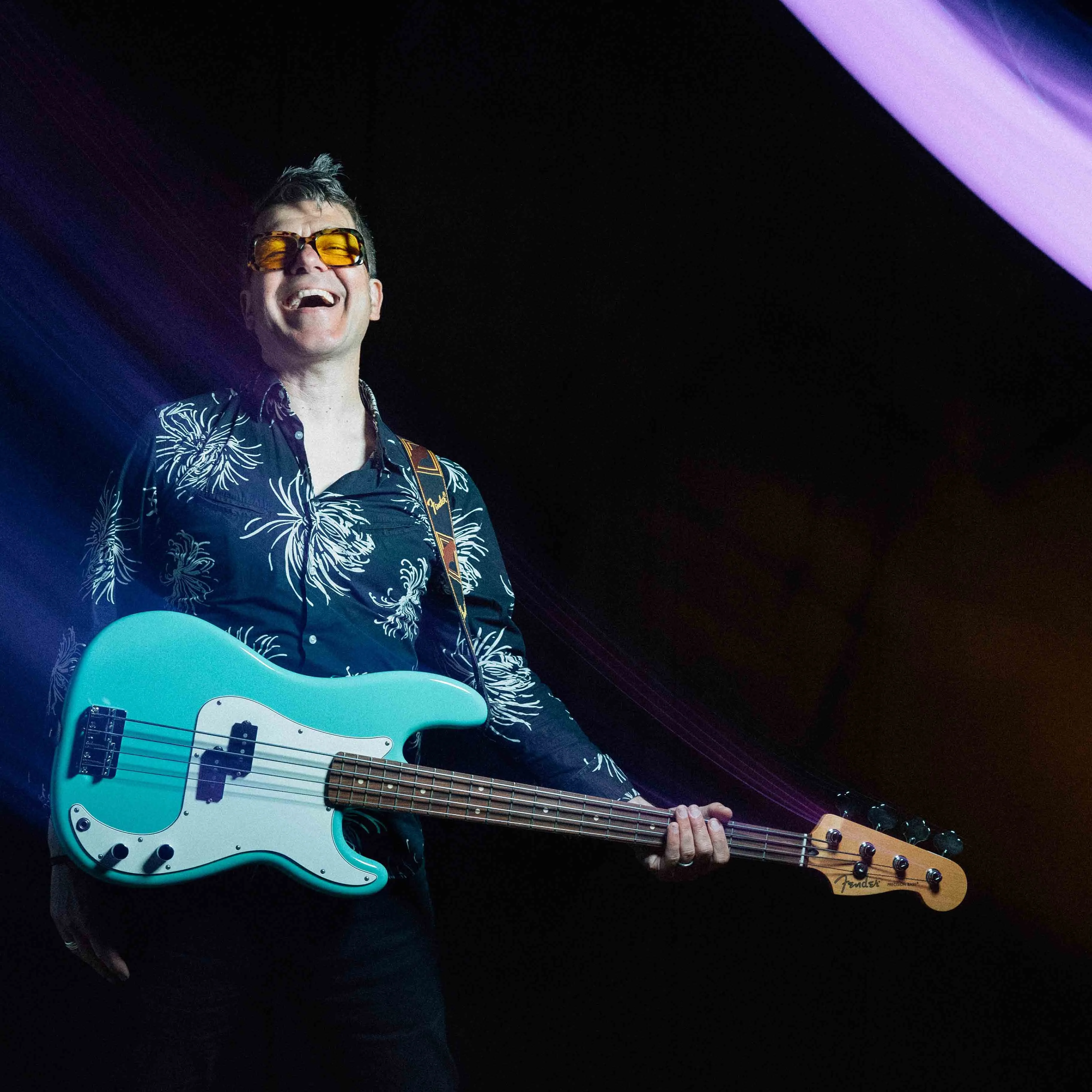
My friend Rob Blackham has photographed me and the Funkestra for many years. He is also a guitarist, and over time we have reached that useful stage where he knows enough about me not to require me to arrive with a precise photographic brief.
For this shoot, he wanted to create different versions of me: the producer, the Funkestra bassist and then something less literal.
For the latter, he used lights, movement and camera technique rather than digitally constructing an effect afterwards. He effectively moved around me with the camera while I stood with the bass.
The final cover image is the result.
At first glance, I am almost a silhouette inside streaks of colour. Look more closely and the four tuning machines of the bass are there too.
I like that the instrument is present without the photograph becoming the usual man-holding-bass-and-looking-meaningful album cover.
Rob also helped choose the final image.
That mattered.
It was not simply a photographer delivering a folder of files and disappearing. It became another collaboration.
And then there is the flamingo
The inner sleeve was developed with my friend Neil J. Hart, who has created a considerable amount of artwork for my projects.
At its centre is an older photograph of me by Monica Dart, originally from the period around Falling From Insanity.
That younger version of me appears to be moving through the image.
Elsewhere there is a much smaller present-day Stefan surrounded by lines, colour and visual information, looking back towards him.
For me, that became a pretty good representation of thirty years.
The person now looking at the person then, surrounded by an unreasonable quantity of ideas.
And a flamingo.
People keep asking about the flamingo.
There is no deeply researched ornithological meaning. It belongs to the other category of ideas that occasionally arrive in my head: the ones where the only sensible response is probably, “Why?”
That side of things is important too.
I take the music seriously.
I am less convinced that I should take myself seriously all of the time.
The bassist as connector
One thought from our conversation stayed with me particularly strongly.
I have always described myself as a supporting bassist.
That should not be confused with a judgement about ability or ambition. Some of the greatest virtuoso bassists in history are also extraordinary supporting musicians.
I mean something more fundamental.
I do not particularly want the bass to dominate my music simply because I happen to be the bandleader.
The bass connects rhythm, harmony and melody. It sits between things. It helps the whole structure make sense.
Looking at the last thirty years, I increasingly realise that this is also how I tend to work.
I connect musicians.
I connect projects.
I bring people into rooms.
I write something and then become interested in what another musician can do to it.
I produce other artists and try to help their ideas become clearer rather than turn them into versions of myself.
Perhaps the instrument suited the person before the person properly understood why.
The problem with calling everything amazing
We also talked about something that has bothered me increasingly: the amount of hyperbole surrounding music.
Everything is extraordinary.
Everybody is exceptional.
Every performance is incredible.
Every release apparently represents a completely unprecedented moment in human culture.
Independent artists are partly trapped by the mechanisms around us. We need to communicate continuously. Streaming platforms reward regular activity. Social media requires another announcement, another piece of content, another reason for somebody to stop scrolling.
I participate in it because I want people to find the music.
But I am trying to become clearer about the distinction between promotion and inflation.
If somebody really is exceptional, explain why.
If a collaboration matters, tell the story that makes it matter.
If a record is worth hearing, give people enough information to understand what distinguishes it.
Then let the work carry some of the weight.
Still here
Thirty years of Funkestra is a strange thing to contemplate because I do not experience it as one continuous thirty-year plan.
There were different bands, different periods, different studios, different countries and plenty of moments when other parts of life occupied more space.
But the music kept returning.
The Funkestra started as the place where I could put my own instrumental music into the world.
It is still that.
The difference now is that the circle around it is considerably wider.
That feels appropriate.
The longer I make music, the less interested I become in proving that I can stand in the middle of it and the more interested I become in finding the people who can make the music better.
FUNKOPIA is perhaps the clearest example of that so far.
And thirty years in, that seems like a useful place from which to begin whatever comes next.
This article draws on my conversation with Michael B, host of 40 Minutes of Funk, for the first instalment of his new 40 Minutes of Funk Further series. Michael and I first spoke on the podcast in October 2021, and his continued support of the Funkestra—and of the wider international funk community—has developed into a friendship I value enormously. My thanks to Michael for inviting me back and for giving musicians the space to tell the stories behind the music.
Listen to the full episode HERE.
Photo credit: Rob Blackham (Blackham Images)